Whether you are a professional contractor or a dedicated DIY enthusiast, your toolbox is your livelihood. Among the most debated topics in the power tool industry is the versatility of specialized equipment, specifically the rotary hammer and the hammer drill. Many users find themselves in a situation where they need to transition from heavy-duty masonry work to delicate woodworking but only have one tool on hand.
Yes, a hammer drill can be used as a regular drill provided it has a selectable mode switch that allows you to turn off the hammering mechanism. When set to the drill-only mode, the tool functions exactly like a standard drill-driver, rotating the bit without the percussive pounding action.
Understanding the nuances of your rotary hammer drill is essential for maintaining tool longevity and ensuring project precision. While the temptation to use one tool for every task is high, knowing when to toggle settings and when to switch machines entirely will save you from ruined materials and broken bits.
This comprehensive guide will explore the mechanics of these tools, providing a deep dive into how you can maximize your investment while maintaining professional standards. We will analyze the differences between various drilling technologies and provide actionable tips for your next project.
Table of Contents
Introduction
What’s the Difference Between a Hammer Drill and a Regular Drill?
How to Use a Hammer Drill as a Regular Drill?
When Can You Use a Hammer Drill as a Regular Drill?
Top 10 Mistakes When Using a Hammer Drill as a Regular Drill
Hammer Drill vs Impact Driver vs Regular Drill: Which Do You Need?
Conclusion
FAQs
Introduction
A hammer drill is a high-performance power tool designed primarily for drilling into hard materials like masonry, stone, and brick by combining rotation with a pulsing hammer action.
At its core, the rotary hammer is built for impact. While a standard drill relies solely on the sharp edges of a drill bit and the pressure applied by the user to shave away material, the hammer drill utilizes an internal mechanism that mimics a rapid series of small hammer blows. This percussive force fractures the substrate, allowing the rotating bit to clear away debris much faster than a standard rotation-only tool ever could.
In the professional B2B sector, efficiency is the benchmark of success. Utilizing a rotary hammer drill on a construction site means faster installation of anchors and conduit. However, the versatility of these tools has evolved. Modern engineering has allowed manufacturers to include bypass switches, essentially giving users two tools in one. This adaptability is why the hammer drill has become a staple in both industrial warehouses and residential workshops.
Understanding the internal physics of the rotary hammer helps in appreciating why it is such a powerhouse. Unlike the smaller, cam-action hammer drills often found in home kits, a true rotary hammer uses a piston mechanism to deliver much harder hits. This makes it a beast in concrete but potentially a liability in soft pine or thin plastic if not managed correctly. Learning to balance this power is the key to mastering your toolset.
What’s the Difference Between a Hammer Drill and a Regular Drill?
The primary difference lies in the mechanical action: a regular drill uses pure rotation to create holes, while a hammer drill adds a rapid back-and-forth pounding motion to help penetrate brittle, hard materials.
To understand the rotary hammer, one must look at the drive system. A standard drill-driver uses a chuck to spin a bit. The user provides the forward force. This is perfect for wood, metal, and plastic where a clean, sheared hole is required. If you try to use a regular drill on high-strength concrete, the friction will quickly overheat the bit, dulling the cutting edges and potentially burning out the drill's motor because there is no mechanism to break the aggregate.
The hammer drill and the rotary hammer drill introduce the "blows per minute" (BPM) factor. In a standard hammer drill, two ribbed discs click against each other as they spin, causing the chuck to hop forward and back. In a professional-grade rotary hammer, an air pressure piston drives the bit forward. This results in much higher impact energy, measured in Joules, allowing the tool to "eat" through stone.
Below is a comparison table to help visualize these technical differences:
| Feature | Regular Drill | Hammer Drill | Rotary Hammer |
| Primary Action | Rotation only | Rotation + Cam-action vibration | Rotation + Piston-driven impact |
| Best For | Wood, Metal, Plastic | Light Masonry, Brick | Concrete, Stone, Heavy Demolition |
| Bit Type | Round or Hex Shank | Masonry (Standard Chuck) | SDS-Plus or SDS-Max |
| Impact Force | Low (Manual pressure) | Moderate (Vibration) | High (Pneumatic Piston) |
| Weight | Lightweight | Medium | Heavy |
How to Use a Hammer Drill as a Regular Drill?
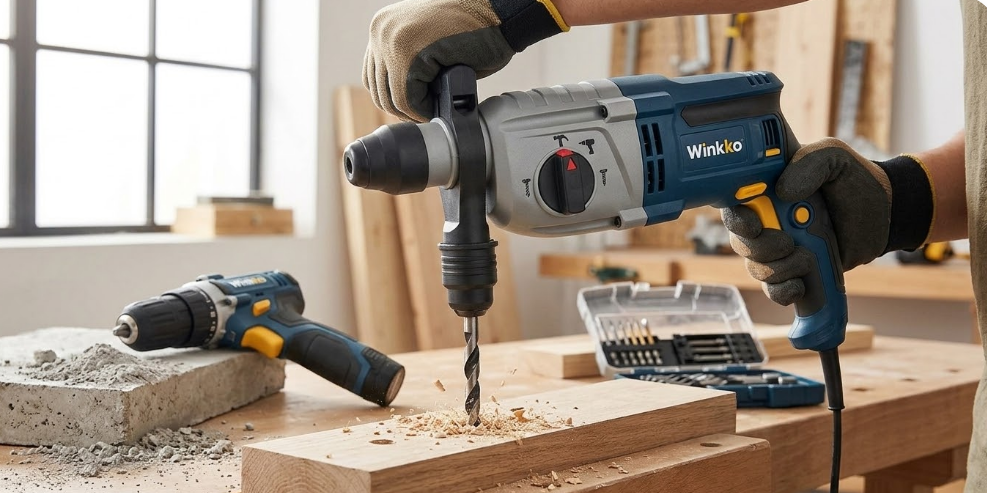
To use a hammer drill as a regular drill, you must locate the mode selector switch—usually marked with a "hammer" icon and a "drill bit" icon—and set it to the drill bit symbol to disengage the percussive mechanism.
The first step in converting your rotary hammer drill for standard use is ensuring the motor is completely stopped before toggling the mode switch. Most professional tools feature a dial on the side or top of the housing. By selecting the "drill-only" mode, you are mechanically locking the piston or cam-action discs so that only the rotational torque is sent to the chuck. This prevents the bit from "bouncing" against the material.
Next, you must consider the chuck type. Many high-end rotary hammer units use an SDS (Slotted Drive System) chuck, which does not accept standard round-shank drill bits. If your tool has an SDS chuck, you will need a chuck adapter to hold regular bits. Once the adapter is in place and the mode is set to "drill," you should adjust the speed trigger. Standard drilling in wood often requires higher RPMs than drilling in concrete, so a variable speed trigger is your best friend here.
Finally, always perform a "dry run" or a test hole in a scrap piece of material. Because a rotary hammer is generally heavier and more powerful than a standard drill, the torque can be surprising. Hold the tool with both hands—using the side handle if available—to maintain steady pressure. This ensures that even though you are using a heavy-duty hammer drill, you achieve the finesse required for delicate woodworking or metal fabrication.
When Can You Use a Hammer Drill as a Regular Drill?
You can use a hammer drill as a regular drill for almost any standard application including boring holes in timber, driving screws into metal studs, or mixing paint, provided the hammer function is turned off.
In a B2B or industrial environment, the "when" is often determined by site logistics. If you are working on a high-rise project and need to install wooden blocking after drilling into concrete slabs, it is far more efficient to flip the switch on your rotary hammer drill than to climb down fifty flights of stairs for a different tool. It is perfectly acceptable for general construction tasks where "construction-grade" precision is the goal.
However, specific scenarios demand this crossover. For instance, when dealing with "multi-material" bits designed to go through wood and then into masonry, the hammer drill is the perfect host. You start in "drill-only" mode to clear the wood without splintering it, then flip to "hammer" mode once the bit hits the brick or concrete behind the wood. This seamless transition is one of the greatest advantages of the modern rotary hammer.
It is important to note that you should avoid using a rotary hammer as a regular drill for high-end cabinetry or fine furniture making. The weight of the tool makes it difficult to maintain the perfect 90-degree angle required for fine joinery. Additionally, the minimum speed of a heavy-duty rotary hammer drill might still be too fast or too high-torque for very small, fragile screws, which could result in stripped heads or split wood.
Top 10 Mistakes When Using a Hammer Drill as a Regular Drill
The most common mistakes include leaving the hammer mode on when drilling wood, using the wrong bits for the material, and failing to secure the secondary handle for torque control.
Forgetting to Switch Modes: This is the number one error. Using hammer action on wood will result in a jagged, splintered hole and can destroy the wood grain.
Using Masonry Bits on Wood: Masonry bits are designed to pulverize, not shear. Using them in "drill-only" mode on wood will cause smoke and friction without actually cutting a hole.
Applying Excessive Pressure: A rotary hammer is heavy. Let the weight of the tool do the work; pushing too hard can cause the bit to wander or the motor to overheat.
Neglecting the Side Handle: The high torque of a rotary hammer drill can twist your wrist if the bit catches. Always use the auxiliary handle for regular drilling tasks.
Using Non-Impact Rated Adapters: If using an SDS-to-standard chuck adapter, ensure it is rated for the power of your specific rotary hammer.
Ignoring Variable Speed: Drilling metal requires slow speeds to prevent bit "blueing," while wood needs higher speeds. Failing to adjust the trigger pull will ruin your bits.
Poor Bit Maintenance: Because these tools are powerful, they put a lot of stress on bits. Using a dull bit in a powerful hammer drill is a recipe for disaster.
Inadequate Cooling: Even in regular drill mode, the larger motors in a rotary hammer generate significant heat. Give the tool breaks during long drilling sessions.
Incorrect Depth Stop Setting: Many users forget to adjust the depth rod when switching from masonry to wood, leading to holes that are too deep.
Ignoring Safety Gear: Just because you aren't "hammering" doesn't mean you don't need eye protection. The high torque can still send wood chips or metal shavings flying at high velocities.
Hammer Drill vs Impact Driver vs Regular Drill: Which Do You Need?
Choosing between these tools depends on the specific task: regular drills are for precision holes, impact drivers are for driving fasteners, and hammer drills/rotary hammers are for masonry penetration.
The regular drill is the baseline. It features a keyless chuck and an adjustable clutch. The clutch is vital because it allows you to set the maximum torque before the drill stops spinning, preventing you from over-driving a screw into soft drywall or wood. It is the king of versatility for light-to-medium tasks.
The impact driver is often confused with a hammer drill, but they serve different purposes. While a rotary hammer applies force forward (parallel to the bit), an impact driver applies rotational force (perpendicular to the bit). Think of an impact driver as a tiny, rapid lug-nut wrench. It is the best tool for driving long lag bolts or deck screws, but it is not designed for drilling into concrete.
The rotary hammer drill is the heavy hitter. It is designed for the toughest environments. If your job involves 70% masonry and 30% other materials, the rotary hammer is your primary tool. If your work is 90% wood and metal, a standard drill is better. For the professional who does it all, having both an impact driver and a rotary hammer usually covers all possible bases.
| Tool | Force Direction | Best Application | Key Advantage |
| Regular Drill | Pure Rotation | Small holes in wood/metal | Precision & Clutch Control |
| Impact Driver | Rotational Impact | Driving screws/bolts | High Torque, no kickback |
| Hammer Drill | Forward Percussion | Light masonry/Brick | Versatile for homeowners |
| Rotary Hammer | Piston Percussion | Concrete/Stone/Tile | Maximum Power & Speed |
Conclusion
In the world of professional power tools, the rotary hammer stands out as a marvel of engineering flexibility. We have established that a hammer drill can indeed be used as a regular drill, provided the user understands how to engage the correct settings and respects the power of the machine. By simply toggling the mode selector, you transform a concrete-crushing beast into a capable rotation-only tool.
However, as we have explored, this versatility comes with responsibilities. Using a rotary hammer drill for standard tasks requires a steady hand, the right adapters, and a keen awareness of the material's limits. For B2B buyers and contractors, investing in a high-quality rotary hammer with a reliable "drill-only" mode is a cost-effective way to streamline operations and reduce tool overhead.
Ultimately, the best tool is the one that is used correctly. Whether you are boring through a 12-inch concrete wall or pre-drilling a hole in a piece of oak, understanding the mechanics of your hammer drill ensures that every job is done with professional-grade accuracy.
FAQs
Can I use a hammer drill for wood?
Yes, you can use a hammer drill for wood as long as the hammer function is switched off. You must use a standard wood-cutting bit and be mindful of the tool's higher torque to prevent the wood from splitting.
Do I need special bits to use a hammer drill as a regular drill?
If your rotary hammer has a standard 3-jaw chuck, you can use regular bits. If it has an SDS-plus chuck, you will need an SDS-plus to 3-jaw chuck adapter to hold standard round-shank drill bits.
Is a rotary hammer the same as a hammer drill?
While they perform similar functions, a rotary hammer is much more powerful. It uses a pneumatic piston to strike the bit, whereas a standard hammer drill uses a mechanical cam-action. For heavy concrete work, the rotary hammer drill is the superior choice.
Can I drive screws with a rotary hammer?
It is possible but not recommended. Even in "drill-only" mode, most rotary hammer units lack the sensitive clutch found on standard drills, making it very easy to strip the screw or drive it completely through the material.
Why is my hammer drill smoking when drilling wood?
This usually happens if the hammer mode is left on or if the bit is dull. The friction of the hammer action or a dull bit generates intense heat, which scorches the wood fibers. Ensure you are in "drill-only" mode and using a sharp bit.


