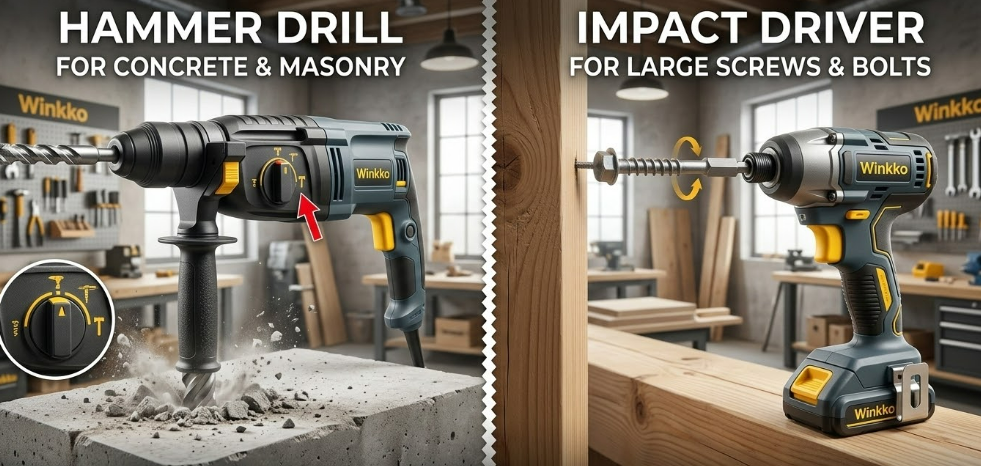
The primary difference between a hammer drill and an impact driver lies in their force delivery: a hammer drill uses a forward-pulsing "hammering" action to pulverize hard materials like concrete and stone, making it synonymous with a rotary hammer drill in heavy masonry work, while an impact driver utilizes a high-torque rotational "concussive" force specifically designed to drive long screws and fasteners into tough timber or metal without stripping the screw head.
Navigating the specifications of these tools requires a deep dive into their mechanical engineering and real-world performance. Whether you are sourcing equipment for a large-scale building site or refining a professional workshop, knowing when to reach for a rotary hammer versus a specialized driver will save time, reduce tool wear, and ensure structural integrity. This guide provides a comprehensive breakdown of these two powerhouses to help you make an informed procurement decision.
Table of Contents
What Is a Hammer Drill?
What Is an Impact Driver?
Key Comparisons Between Hammer Drills and Impact Drivers
Hammer Drill vs. Impact Driver: Choosing the Right Tool Based on Usage Scenarios
Conclusion
FAQs
What Is a Hammer Drill?
A hammer drill is a high-performance power tool designed to drill holes into hard, brittle surfaces like masonry, brick, and stone by combining standard rotation with a rapid, longitudinal pulsing action.
The mechanical soul of a rotary hammer or a high-end hammer drill is its ability to "percuss." Unlike a standard drill that relies solely on the sharpness of the bit and the pressure applied by the user, the hammer drill features an internal mechanism—often two ribbed discs or a piston in a rotary hammer drill—that strikes the drill bit forward as it spins. This action creates a repetitive chipping motion that pulverizes the material at the tip of the bit, allowing the flutes to whisk away the dust. This is why a rotary hammer is the gold standard for any task involving concrete or reinforced masonry.
When discussing the rotary hammer, it is important to note the different scales of power. Smaller hammer drills use a "ratchet" style mechanism suitable for light brickwork, whereas a true rotary hammer drill utilizes a pneumatic piston. This pneumatic action delivers much higher impact energy, measured in Joules, making the rotary hammer indispensable for heavy-duty anchoring and through-hole drilling in solid poured concrete. For B2B applications, investing in a rotary hammer ensures that the workforce can handle demanding geological or structural substrates without burning out the motor.
Furthermore, a rotary hammer drill often features multiple modes of operation. Most professional-grade rotary hammer units allow the user to switch between "rotation only" (for wood or metal), "hammer with rotation" (for masonry drilling), and "hammer only" (for light demolition or chiseling). This versatility makes the rotary hammer a foundational tool for electrical contractors, plumbers, and HVAC technicians who must frequently penetrate foundation walls or floor slabs to install piping and conduit.
What Is an Impact Driver?
An impact driver is a specialized tool engineered to deliver massive amounts of rotational torque through an internal "hammer and anvil" mechanism, specifically optimized for driving large fasteners and screws into dense materials.
The operational logic of an impact driver is significantly different from that of a rotary hammer. While a rotary hammer drill pushes forward, the impact driver "kicks" in the direction of the rotation. When the tool encounters significant resistance—such as a long lag bolt entering a pressure-treated beam—the internal spring-loaded hammer strikes the anvil. This creates a high-pressure burst of rotational force. This mechanism allows the tool to maintain constant contact with the screw head, drastically reducing "cam-out" (the bit slipping out of the screw) and preventing user fatigue by absorbing the reactionary torque.
In professional environments, the impact driver is the preferred choice for repetitive fastening tasks. Its compact, stubby profile allows it to fit into tight corners where a bulky rotary hammer or even a standard drill/driver would be too cumbersome. Most impact drivers use a 1/4-inch hex-shank quick-release collet, which is designed for high-torque bits. This specialized chuck ensures that the bit stays locked in place even under extreme vibration, a common occurrence when driving self-tapping screws into heavy-gauge steel or thick wood posts.
The efficiency of an impact driver cannot be overstated for B2B assembly lines or timber framing projects. Because the impact energy is rotational rather than longitudinal, it doesn't require the same "lean-in" pressure from the operator that a hammer drill or rotary hammer drill necessitates. This makes it an ergonomic lifesaver for workers who spend eight hours a day installing cabinetry, decking, or subflooring. While it lacks the masonry-crushing power of a rotary hammer, its precision and raw twisting power make it the king of the fastener world.
Key Comparisons Between Hammer Drills and Impact Drivers
The primary differences between these tools can be summarized by their mechanical direction of force, the types of chucks they use, and their specific material compatibility.
Mechanical Action and Force Direction
The most fundamental difference is the direction of the "strike." A rotary hammer drill delivers force along the axis of the bit, literally pounding the bit into the material like a miniature jackhammer. This is why the rotary hammer is so effective against rock and concrete; these materials are strong under compression but weak against impact. Conversely, the impact driver delivers force perpendicular to the bit, focusing all energy on turning the screw. If you tried to use an impact driver to drill a 1-inch hole in concrete, you would likely overheat the motor without making much progress, whereas a rotary hammer would breeze through it.
Chuck Design and Bit Compatibility
Professional rotary hammer units typically utilize an SDS (Slotted Drive System) chuck. Unlike a standard keyed or keyless chuck that grips a round shank, the SDS chuck allows the bit to slide back and forth freely within the housing. This movement is crucial for the rotary hammer drill to deliver its full impact energy to the substrate without the chuck absorbing the blow. Impact drivers, however, almost exclusively use a 1/4-inch hex collet. This design is optimized for quick bit changes and ensures that the high torque doesn't cause the bit to spin inside the chuck, a common failure point for traditional drills.
Performance Metrics
When evaluating these tools for B2B procurement, look at the following data points:
| Feature | Hammer Drill / Rotary Hammer | Impact Driver |
| Primary Force | Longitudinal (Forward Impact) | Rotational (Torque Impact) |
| Measurement | BPM (Blows Per Minute) / Joules | IPM (Impacts Per Minute) / Inch-Lbs |
| Best Substrate | Concrete, Brick, Stone | Wood, Metal, Plastics |
| Primary Task | Drilling Large Holes / Chiseling | Driving Screws and Bolts |
| Typical Chuck | SDS-Plus or SDS-Max | 1/4" Hex Collet |
The rotary hammer drill is measured by its impact energy (Joules). A higher Joule rating means the rotary hammer can drill larger holes faster. The impact driver is measured by its torque (typically in inch-pounds or Newton-meters), indicating how much resistance it can overcome when tightening a bolt.
Hammer Drill vs. Impact Driver: Choosing the Right Tool Based on Usage Scenarios
Choosing between a rotary hammer and an impact driver depends entirely on whether your primary goal is to penetrate a hard mineral surface or to secure fasteners into a structural frame.
Masonry and Concrete Infrastructure
For any B2B project involving foundation work, electrical mounting on concrete walls, or plumbing through-holes, the rotary hammer is the undisputed winner. If the job involves drilling a hole larger than 1/4 inch into concrete, a standard hammer drill will struggle, generating heat and potentially breaking the carbide tip of the bit. A rotary hammer drill, with its pneumatic power, removes the physical effort required by the operator. In industrial scenarios where hundreds of anchors must be set per day, the efficiency of the rotary hammer significantly reduces labor costs and tool replacement frequency.
Timber Framing and Metal Assembly
If the project involves building a timber frame warehouse, installing cabinetry, or assembling metal racking, the impact driver is the superior choice. Its ability to drive long lag screws without the need for a pilot hole (in many cases) makes it a speed demon on the job site. While you could technically use a rotary hammer in its "rotation only" mode to drill wood, it would be heavy, imprecise, and likely to over-torque small screws. The impact driver’s weight and size make it ideal for overhead work and long shifts where worker fatigue is a concern.
Versatility and Hybrid Use Cases
In some specialized scenarios, the lines can blur. For instance, when installing Tapcon screws (concrete screws), you actually need both tools. You use the rotary hammer drill to create the pilot hole in the masonry and then use the impact driver to thread the screw into that hole. For B2B buyers, this highlights the necessity of purchasing these tools in "combo kits." Relying on a rotary hammer for everything will lead to broken fasteners, while relying on an impact driver for everything will lead to burnt-out motors and ruined masonry bits.
Conclusion
In the debate of rotary hammer versus impact driver, the answer is rarely "which is better" and almost always "which is right for this specific task." The rotary hammer drill remains the powerhouse of the masonry world, utilizing pneumatic force to conquer concrete and stone with an efficiency that no other tool can match. Meanwhile, the impact driver is the precision instrument of the fastening world, providing the rotational torque necessary to secure structures without the risk of stripped heads or wrist-straining kickback.
For businesses looking to optimize their tool cribs, understanding the core keyword—the rotary hammer—is vital. It represents the "heavy lifting" side of construction. Integrating high-quality rotary hammer drill units alongside specialized impact drivers ensures that your team is prepared for any substrate, from the densest reinforced concrete to the toughest structural steel. By matching the mechanical action of the tool to the physical properties of the material, you ensure faster project completion, higher safety standards, and a longer lifespan for your equipment.
Would you like me to help you compare specific rotary hammer models or provide a procurement checklist for your next project?
FAQs
Can I use a rotary hammer to drive screws?
While some rotary hammer drill units have a "rotation only" mode and can accept a chuck adapter for screwdriver bits, it is generally not recommended. The rotary hammer is far too heavy and powerful for standard screws, and the lack of a sensitive clutch means you will likely snap the screw head or drive it straight through the material. An impact driver is the correct tool for this task.
Why do I need a rotary hammer if I already have a hammer drill?
A standard hammer drill is essentially a traditional drill with a "clapping" mechanism. It is fine for occasional small holes in light brick. However, a rotary hammer uses a pneumatic piston to deliver much harder hits. If you are a professional working with concrete regularly, a rotary hammer drill will work significantly faster and last years longer than a standard hammer drill.
Is an SDS bit required for all rotary hammers?
Yes, the vast majority of modern rotary hammer units use the SDS-Plus or SDS-Max shank system. These bits have grooves that allow them to slide within the chuck, which is essential for the tool's hammering action. You cannot use standard round-shank bits in an SDS rotary hammer drill without a specialized adapter, and even then, you lose the hammering efficiency.
Does an impact driver require special bits?
Yes, because of the high concussive torque, you should use "impact-rated" bits. Standard bits are made of harder, more brittle steel that can shatter under the intense rotational impacts of an impact driver. Impact-rated bits are designed to flex slightly, absorbing the energy and lasting much longer.


