Picture this. You are lying on a cold garage floor, wrestling with a rusted, overtightened lug nut that absolutely refuses to budge. Your knuckles are scraped. Your breaker bar is bending dangerously. Your patience is completely exhausted. Does this sound familiar? It is a scenario every mechanic, contractor, and dedicated DIY enthusiast dreads. Fortunately, a cordless impact wrench serves as the ultimate problem-solver for these heavy-duty headaches. It instantly turns hours of agonizing labor into a task that takes mere seconds.
Today, the landscape of industrial and automotive repair has dramatically shifted. Taking a broader look at the global tooling market, recent industry analysis highlights a massive, ongoing migration from pneumatic systems to battery-operated fastening tools across the heavy construction and automotive sectors. This industry-wide trend is largely driven by stricter workplace safety regulations aiming to eliminate trip hazards caused by sprawling air hoses. Furthermore, the growing need for decentralized maintenance—where technicians must repair massive equipment in remote locations—has made untethered electric tools an indispensable asset for modern operational efficiency. Thanks to rapid advancements in high-discharge lithium-ion battery technology, highly portable devices now dominate the market. They offer absolute freedom without sacrificing raw rotational force.
In this comprehensive guide, we will explore the fascinating internal mechanics of this indispensable device. We will examine the highly specialized tasks it effortlessly conquers and provide a detailed roadmap for selecting the perfect model for your workshop. Specifically, we will highlight a top-tier option designed to meet the rigorous demands of both professionals and hobbyists.
Key Takeaways
Power and Portability: Modern battery-powered wrenches combine massive torque output with the freedom to work anywhere. This permanently eliminates the need for cumbersome air compressors and restrictive hoses.
Versatility in Special Tasks: From intricate automotive suspension teardowns to heavy timber construction and remote industrial maintenance, this instrument is the primary choice for loosening and driving large, high-stress fasteners.
Crucial Buying Metrics: When evaluating a potential purchase, understanding breakaway torque, fastening torque, drive size, and the inclusion of a high-efficiency brushless motor are the most critical factors for long-term satisfaction.
Safety and Technique: Utilizing proper impact-rated sockets and mastering trigger control are essential practices. These habits prevent catastrophic hardware failure and protect the operator.
Top Recommendation: The Winkko HIW208BL stands out as a premium, value-driven choice that delivers professional-grade performance for the most demanding environments.
What is a Cordless Impact Wrench and How Does It Work?
To truly appreciate the capability of this equipment, one must understand the brilliant engineering hidden inside its casing. A cordless impact wrench is a high-torque fastening tool explicitly engineered to deliver strong, sudden rotational forces to a nut or bolt. Unlike a standard power drill that relies on continuous, steady rotational force—which would violently twist your wrist if the bit got stuck—this tool utilizes a specialized internal mechanism designed to maximize torque while minimizing the reactive force felt by the operator.
The core of this technology is the hammer and anvil mechanism. When you pull the trigger and the electric motor spins, it rotates a heavy cylindrical metal mass known as the hammer. As long as the fastener turns easily, the tool functions smoothly, much like a standard drill. However, the moment the tool encounters significant resistance, such as a cross-threaded bolt or a rusted nut, a heavy-duty spring mechanism engages. This spring allows the hammer to slip off the anvil, spin freely to build momentum, and then violently crash into the anvil wings.
These rapid, high-energy impacts occur thousands of times per minute. From an engineering perspective, they transfer massive spikes of kinetic energy directly into the output shaft. This effectively shocks stubborn fasteners loose. The brilliance of this design is that the concussive force is directed entirely into the bolt, not back into the user arm.
The cordless advantage cannot be overstated. Just a decade ago, achieving this level of concussive force required a massive air compressor. In contrast, modern electric wrenches utilize advanced lithium-ion cells capable of discharging massive amounts of current instantaneously. This allows a handheld, battery-powered tool to rival, and frequently exceed, the nut-busting power of traditional pneumatic systems.
Cordless Impact Wrench vs. Impact Driver
A frequent point of confusion among consumers entering the power tool market is the distinction between an impact driver and an impact wrench. While both utilize a similar hammer-and-anvil concept, their applications, power outputs, and physical designs differ vastly. To clarify these differences, review the comparison table below.
Feature
Cordless Impact Wrench
Impact Driver
Drive Type
Square Drive typically 3/8-inch, 1/2-inch, or 3/4-inch
1/4-inch Quick-Release Hex Collet
Torque Measurement
Foot-pounds or Newton-meters
Inch-pounds
Power Output
Extremely High designed for heavy-duty resistance
Moderate designed for speed and wood fastening
Primary Application
Automotive repair, structural steel, heavy machinery
Decking, cabinetry, light metal fastening
Accessory Type
Heavy-duty impact sockets
Hex-shank screwdriver bits and small drill bits
If you are building a wooden deck, grab the driver. Conversely, if you are changing a tire or rebuilding a diesel engine, you need the wrench.
Special Tasks: Where the Cordless Impact Wrench Shines
The true value of this equipment becomes vividly apparent when examining its practical applications in the field. It is not merely a luxury for the weekend warrior. In many professional scenarios, it is a strict necessity for completing special tasks efficiently and safely.
Automotive Repair and Maintenance
In the automotive sector, this tool is nothing short of revolutionary. The most ubiquitous application is tire removal. Lug nuts are frequently overtightened by overzealous technicians using uncalibrated pneumatic guns at repair shops. Furthermore, these nuts often fuse to the wheel hub due to galvanic corrosion and winter road salt. A high-torque electric wrench can blast these seized nuts off in fractions of a second.
Beyond simple tire changes, seasoned mechanics rely heavily on this instrument for complex vehicle teardowns. Suspension components, such as control arm bolts, sway bar links, and rusted strut mounts, are notoriously difficult to remove manually. The rapid, concussive force of the impact mechanism effectively shatters the rust bonds holding the hardware together. This drastically reduces the risk of snapping the bolt head off, a mistake that often leads to hours of drilling and tapping.
Heavy Construction and Carpentry
While standard drills and impact drivers handle drywall and decking, heavy structural construction requires significantly larger fasteners that demand immense power. Framing contractors frequently utilize impact wrenches to drive thick, long lag bolts into dense structural timber. This secures load-bearing beams without needing to pre-drill massive pilot holes.
In the realm of commercial construction, steel erectors use these powerful tools to quickly assemble multi-story scaffolding and secure structural steel beams with high-tensile bolts. When working with concrete, contractors rely on them to drive heavy-duty wedge anchors and screw anchors deep into masonry. This specific task requires sustained, high-level torque that would instantly stall or burn out the motor of a conventional drill.
Agricultural and Industrial Equipment
Agricultural and industrial environments present unique logistical challenges, primarily because the equipment involved is massive and often breaks down far away from traditional power sources. Imagine a combine harvester throwing a belt or snapping a blade in the middle of a muddy, 500-acre field. Towing an air compressor out to the site is entirely impractical.
In these critical moments, maintenance crews utilize a battery-powered cordless impact wrench to replace heavy tractor implement blades, repair industrial conveyor belts, and maintain sprawling factory machinery. The absolute portability of the tool allows technicians to maneuver around complex, dangerous machinery without tripping over pneumatic hoses. This significantly improves both workplace safety and repair speed.
Comprehensive Guide: How to Choose the Best Cordless Impact Wrench
Selecting the right tool is not as simple as buying the most expensive model on the shelf. It requires a nuanced understanding of your specific project requirements. You must carefully align the tool technical capabilities with your workflow to avoid under-powering your garage or overspending on unnecessary industrial capacity.
Understanding Torque Ratings
Torque is the fundamental measure of rotational force applied to a fastener, typically quantified in foot-pounds or Newton-meters. When evaluating spec sheets, you will notice manufacturers advertise two distinct torque ratings, which serve very different purposes.
Breakaway Torque: Also known as nut-busting torque, this represents the maximum force the tool can exert in reverse to loosen a stuck, rusted, or overtightened fastener. It is always the higher of the two numbers because overcoming static friction and breaking chemical rust bonds requires a massive, instantaneous spike in energy. For automotive work, this is the most critical metric.
Fastening Torque: This is the maximum sustained force the tool can apply when driving or tightening a bolt forward. It is naturally lower than breakaway torque because driving a bolt relies on kinetic friction, which requires less baseline force. Always ensure the fastening torque meets the specifications of the heavy machinery you are assembling.
The Importance of a Brushless Motor
Modern power tools feature either traditional brushed motors or advanced brushless motors. If you are investing in high-demand equipment, selecting a model with a brushless motor is practically mandatory.
Older brushed motors use physical carbon blocks known as brushes that rub constantly against a spinning commutator to transfer electricity. This physical friction generates massive amounts of heat, wastes battery energy, and eventually causes the brushes to wear out, requiring replacement.
In contrast, brushless motors utilize a smart electronic circuit board to coordinate the delivery of electricity to electromagnets, entirely eliminating physical contact. Consequently, this leads to dramatically higher efficiency, extending battery run-time by up to fifty percent per charge. Furthermore, less energy lost to friction means more raw power is delivered directly to the anvil. Finally, these motors run significantly cooler under heavy loads and boast a zero-maintenance lifespan.
Drive Size and Anvil Type
The square drive protruding from the front of the tool, known as the anvil, dictates the size of the sockets you can attach and generally indicates the overall power class of the machine.
A 3/8-Inch Drive is incredibly compact, making it ideal for tight spaces such as cramped engine bays, under-dash automotive work, and motorcycle repair. It offers moderate torque suitable for smaller hardware.
The 1/2-Inch Drive is the undisputed industry standard. It provides the perfect equilibrium of physical size and raw power, easily capable of handling the vast majority of automotive and construction tasks, including stubborn lug nuts and rusted suspension bolts.
3/4-Inch and 1-Inch Drives are massive, heavy tools reserved strictly for extreme industrial tasks, heavy diesel truck mechanics, and structural steel bridge work.
Additionally, you must choose between two socket retention systems. A Friction Ring, commonly called a hog ring, uses a compressible metal ring to hold the socket, allowing for rapid, tool-free socket changes. This makes it the favorite among fast-paced mechanics. A Detent Pin features a spring-loaded pin that locks securely into a hole on the socket. It requires a small tool to press the pin to release the socket, which is highly preferred by construction workers operating at heights to prevent sockets from dangerously falling on workers below.
Battery Platform
The performance of any electric fastening tool is intrinsically tied to its power source. Most professional-grade tools operate on an 18V or 20V Max battery platform. It is worth noting that these are functionally identical. The 20V rating represents the peak voltage immediately off the charger, while 18V is the nominal operating voltage under load.
Equally important as voltage is the battery Amp-hour rating, which effectively acts as the size of the fuel tank. High-torque impacts draw massive surges of electrical current. Pairing a heavy-duty tool with a small battery will result in severe voltage sag, preventing the motor from reaching its maximum torque potential. For optimal, sustained performance, always pair your tool with a high-capacity battery, typically 4.0 Amp-hours, 5.0 Amp-hours, or higher.
Spotlight: The Winkko HIW208BL Cordless Impact Wrench
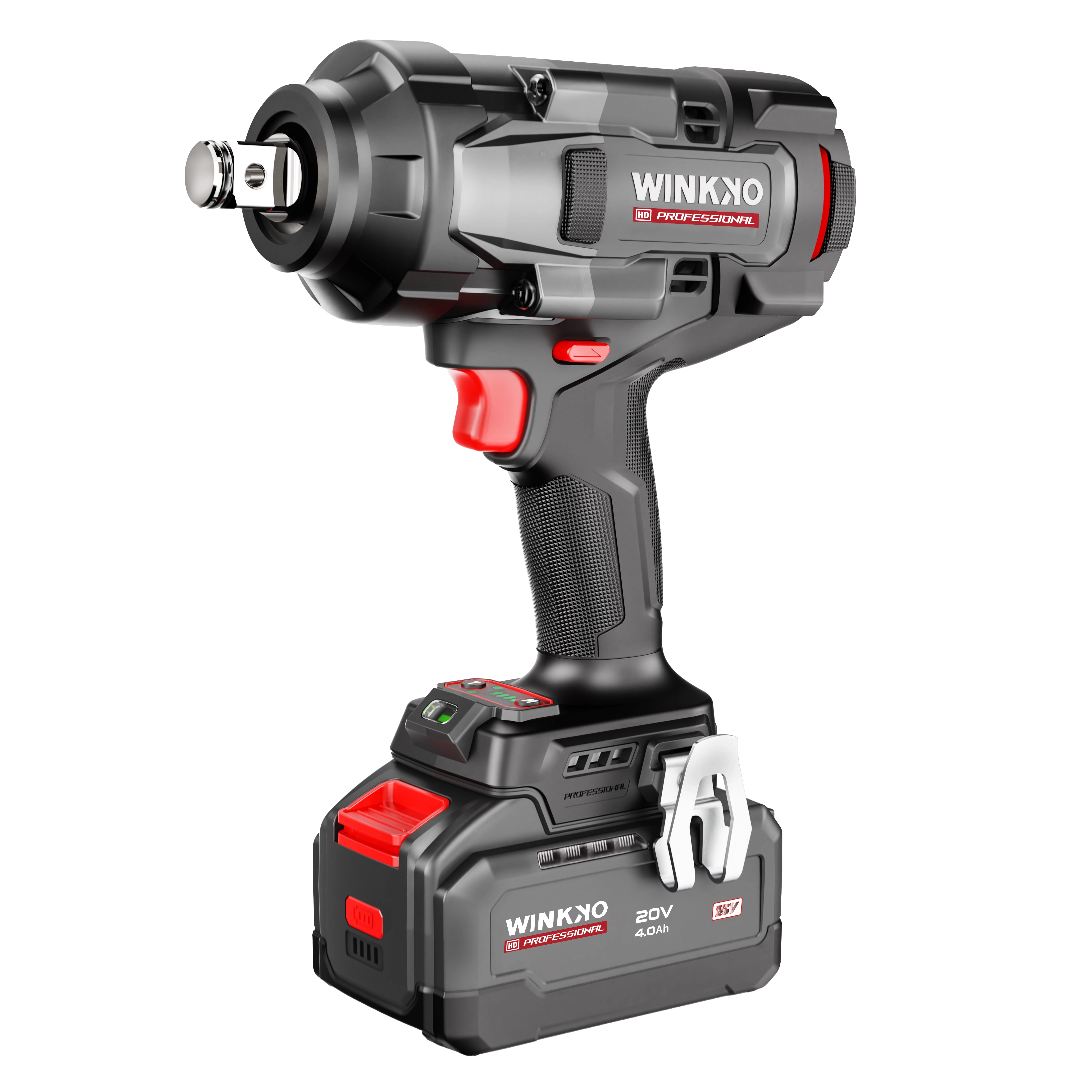
When navigating the crowded market for a tool that successfully marries raw power, ergonomic comfort, and advanced internal engineering, specific models naturally rise above the rest. A shining example of modern tool manufacturing is the Winkko 20V brushless impact wrench. It is an instrument meticulously designed to meet the rigorous demands of both professional mechanics and serious DIY enthusiasts.
Key Features and Specifications
Take the Winkko HIW208BL as a prime example of modern engineering. It integrates a 20V high-discharge battery system with a frictionless brushless motor. This configuration delivers sustained breakaway torque through a standard 1/2-inch square drive, ensuring you have the exact specifications needed for automotive teardowns. By utilizing this high-efficiency system, the tool ensures maximum energy transfer from the battery directly to the anvil. This translates to vastly longer run times, much cooler operating temperatures during prolonged, heavy-duty use, and an extended overall lifespan without the hassle of motor maintenance.
Moreover, it is engineered for optimized torque delivery. Built specifically for heavy-duty applications, it provides robust breakaway torque capable of shattering the rust on stubborn lug nuts, unseating seized suspension bolts, and driving large structural fasteners into timber with effortless ease.
Despite its formidable power output, the design remains surprisingly ergonomic and compact. The tool features a perfectly balanced weight distribution and an over-molded, textured rubber grip. This intense focus on ergonomics drastically reduces operator hand and wrist fatigue. This is a critical factor when working on extended weekend projects or maneuvering in awkward positions underneath a vehicle chassis.
Why It Stands Out
The power tool market is frequently dominated by heavily advertised legacy brands that attach a significant premium markup to their products simply for the logo on the side. The Winkko HIW208BL positions itself as a remarkably smart, top-tier investment by offering professional-grade specifications without the inflated price tag. It features top-tier brushless technology, variable speed triggers, and high-capacity battery compatibility. It represents a highly objective, value-driven choice for users who demand absolute reliability and uncompromised power for their most challenging mechanical projects.
Pro Tips for Mastering Your Cordless Impact Wrench
Acquiring a powerful piece of equipment is only the first step. Utilizing it correctly is what separates amateurs from professionals. Mastering proper technique ensures the longevity of the tool, prevents catastrophic damage to your project materials, and keeps you safe.
Always Use Impact-Rated Sockets
One of the most critical, non-negotiable safety rules in any shop is to never, under any circumstances, use standard chrome hand-tool sockets with an impact wrench.
Standard chrome-vanadium sockets are heat-treated to be extremely hard and rigid. While this prevents them from rounding off under slow, manual pressure from a hand ratchet, it makes the metal highly brittle. When subjected to the violent, high-speed concussive blows of an internal hammer mechanism, chrome sockets can literally shatter like glass, sending razor-sharp metal shrapnel flying across the garage.
Instead, you must exclusively use impact-rated sockets. These are typically manufactured from a different alloy known as chrome-molybdenum steel. They are easily identified by their thick walls and matte black oxide coating. This specific metallurgical composition is slightly softer and far more ductile. It allows the socket to microscopically flex and absorb the violent shock of the hammer blows without fracturing.
Preventing Overtightening and Cross-Threading
An electric wrench is incredibly efficient, but its blinding speed can quickly become a liability during the reassembly phase. If a bolt or nut is even slightly misaligned when you pull the trigger, the massive torque will force the hardware into the hole anyway. This instantly destroys the delicate metal threads, creating a nightmare scenario known as cross-threading.
To completely prevent this, seasoned professionals always practice the hand-start rule. You should manually thread the nut or bolt by hand for at least three to four full rotations to ensure the threads are perfectly aligned and engaged. Only after the fastener is smoothly tracking should you reach for the power tool to drive it home.
Utilizing Speed and Power Settings
Modern premium models feature electronic control panels located at the base of the tool, offering multiple speed and torque modes. Learning to use these is vital for precision work.
When you are trying to break loose a rusted suspension bolt, you want the tool on its highest, most aggressive setting. However, when reassembling smaller components, you should always select the lowest speed setting to prevent snapping bolt heads. Additionally, many advanced tools feature an auto-stop or precision fastening mode. In this intelligent setting, the tool will drive the fastener quickly until it senses resistance. At that point, it will automatically shut off or slow down to a crawl, allowing you to finish the tightening process precisely with a manual torque wrench.
Essential Maintenance and Safety Protocols
To protect your financial investment and ensure your personal safety, strict adherence to basic maintenance and safety protocols is required every time you step into the workspace.
Safety Gear
The sheer violence of the tool operation presents specific environmental hazards. First, eye protection is mandatory. As the wrench blasts loose rusted bolts, it frequently dislodges sharp flakes of iron oxide, caked dirt, and metal shavings at high velocities. Wearing ANSI Z87.1-rated safety glasses will save your vision.
Secondly, hearing protection cannot be ignored. The internal metal-on-metal striking of the hammer and anvil generates an incredibly sharp, deafening clatter, often exceeding 100 decibels. This is especially true when echoing in an enclosed garage. Prolonged exposure to this noise level will cause permanent hearing damage, making high-quality earmuffs or foam earplugs an essential part of your uniform.
Tool Maintenance
While the internal brushless motor is effectively maintenance-free, the exterior components and battery systems demand routine attention to ensure peak performance.
Periodically apply a very light coat of machine oil or specialized tool grease to the metal anvil and the friction ring. This simple step prevents surface rust from forming and ensures your heavy sockets slide on and off the tool smoothly. Furthermore, battery care is paramount. Lithium-ion chemistry degrades rapidly if exposed to extreme temperatures. Never leave your batteries sitting in a freezing truck bed overnight or baking inside a hot shed during the summer. Instead, store them indoors at a stable room temperature. Finally, routinely wipe the metal contact points on both the tool base and the battery pack with a dry, clean cloth to ensure an optimal electrical connection and prevent performance-robbing voltage drops.
Conclusion
The era of struggling with hand tools and breaker bars is firmly in the rearview mirror. Today, the cordless impact wrench is no longer viewed as just an expensive luxury reserved for professional mechanics in high-end shops. It is a fundamentally mandatory instrument for anyone looking to tackle heavy-duty, special tasks efficiently. From swapping tires on the side of the highway to framing a new addition on a house, the ability to deliver massive, untethered rotational force changes the way you approach projects.
Choosing a tool equipped with a high-efficiency brushless motor, adequate breakaway torque, and a reliable, high-capacity battery platform will undoubtedly save you countless hours of frustrating, back-breaking labor. Whether you are outfitting a commercial garage or upgrading your home workbench, investing in a premium cordless impact wrench ensures you have the raw power required to conquer the toughest hardware. Explore the full range of high-performance tools at Winkko, upgrade your toolkit today, respect the power of the device, and approach your next major project with absolute confidence.
FAQ
Can I use a cordless impact wrench for drilling holes?
While it is technically possible if you purchase special hex-to-square adapters, it is highly discouraged. A cordless impact wrench is explicitly designed for high-torque fastening, not the smooth, continuous, high-speed rotation required for drilling clean holes. The concussive impacts can easily shatter drill bits or damage the material you are working on. Always use a standard drill for making holes.
How much torque do I need to remove car lug nuts?
For standard passenger vehicles, sedans, and light SUVs, a tool boasting at least 250 to 300 foot-pounds of breakaway torque is usually more than sufficient to remove lug nuts. However, if you are working on larger heavy-duty pickup trucks, agricultural equipment, or vehicles exposed to heavy winter road salt, you will want a tool that delivers over 400 foot-pounds to ensure you are never left stranded.
Are brushless cordless impact wrenches worth the extra money?
Absolutely. While they carry a slightly higher initial purchase price, brushless motors generate significantly less internal friction, run much cooler under heavy strain, deliver higher peak torque, and can extend your battery life by up to fifty percent per charge compared to older brushed motors. Over the lifespan of the tool, the performance and durability gains make it a highly worthwhile investment.
Can a cordless impact wrench overtighten bolts?
Yes, very easily. Because these tools deliver such massive amounts of torque so rapidly, holding the trigger for even a second too long can stretch the bolt threads, crush the material, or snap the fastener entirely. This is exactly why it is crucial to use the tool only for removal or running the bolt down snugly, and then always use a calibrated manual torque wrench to finish tightening critical components such as lug nuts or internal engine parts to the manufacturer exact foot-pound specifications.
What is the difference between a hog ring and a detent pin?
A hog ring utilizes a compressible metal band on the anvil that holds the socket via friction. It allows for quick, tool-free socket changes, making it ideal for mechanics who constantly swap socket sizes. A detent pin features a spring-loaded metal pin that physically locks into a hole on the side of the socket. It requires a small object such as a nail or pen to depress the pin before the socket can be removed, offering maximum security. This is preferred by construction workers working on scaffolding, where a dropped socket poses a severe safety hazard.
Can I use regular chrome sockets with an impact wrench?
No, you should never use standard chrome hand-tool sockets with an impact wrench. Chrome sockets are made from a brittle metal alloy that cannot withstand the violent concussive blows of an impact tool. They are highly prone to shattering, which can cause severe injury from flying metal shrapnel. Always use black oxide, impact-rated sockets made from softer, more ductile chrome-molybdenum steel.
What size drive is best for general automotive repair?
For general automotive repair, the 1/2-inch square drive is universally recognized as the best choice. It provides the perfect balance of physical size and torque capacity. A 1/2-inch drive tool is powerful enough to handle stubborn lug nuts, rusted suspension bolts, and heavy engine mounts, while still being manageable enough for everyday garage use.