Are heavy air hoses still slowing down your assembly line? Anyone who has dragged a polyurethane air line across a crowded shop floor knows the frustration. Pneumatic tools create dangerous trip hazards and severely limit mobility on active job sites. Fortunately, upgrading to a high-performance cordless rivet gun completely eliminates this logistical nightmare. In this comprehensive guide, we will explore exactly why these untethered devices have become the new baseline for modern manufacturing and construction. We will break down their raw pulling power, daily operational benefits, and the undeniable financial return they deliver to professional tradespeople.
Key Takeaways
The shift from traditional air-powered fastening to battery platforms is not a temporary fad. It represents a permanent evolution in industrial operations. Facility managers and field technicians must grasp these core advantages to maintain peak efficiency. Here is what you need to know about modern battery-powered fastening:
Unrestricted Portability: Ditching stationary air compressors allows technicians to navigate complex elevated platforms and confined vehicle cabins freely.
Uncompromised Power: Advanced brushless motors now deliver the exact same pulling force and cycle speed as heavy-duty pneumatic equivalents.
Lower Total Cost of Ownership: The initial tool cost might be higher. However, facilities save thousands long-term by eliminating compressor maintenance, air leak waste, and daily lubrication.
Broad Industry Adoption: These untethered tools are now standard issue across aerospace, HVAC, automotive repair, and commercial roofing.
The Current Landscape: Why the Industry is Shifting
Recent market analyses highlight a massive migration toward untethered tooling ecosystems. Driven by lean manufacturing principles and increasingly strict workplace safety mandates, industrial sectors are systematically phasing out pneumatic infrastructures. What is driving this massive shift? The answer lies in labor optimization. Skilled labor is expensive. When technicians waste time waiting for compressor tanks to fill or untangling snagged hoses, productivity plummets. Consequently, engineering firms and construction conglomerates are investing heavily in battery platforms. This transition allows teams to standardize their equipment, improve safety compliance, and ultimately drive up their profit margins per project.
The Evolution of Riveting: From Manual and Pneumatic to Cordless
To truly appreciate the technological leap of modern fastening, we must look at how we got here. Every generation of tools solved a specific problem, eventually paving the way for the highly optimized systems we rely on today.
The Era of Manual Hand Riveters
For decades, manual pop riveters were the default choice for low-volume tasks. They were highly portable but demanded exhausting physical exertion. Imagine squeezing a manual tool hundreds of times during a single shift. Setting standard aluminum rivets required substantial grip strength. Attempting to snap structural steel fasteners manually often resulted in severe repetitive strain injuries. Furthermore, their agonizingly slow cycle times made them completely useless for large-scale manufacturing.
The Reign of Pneumatic Systems
To combat operator fatigue, the industry universally adopted pneumatic rivet guns. Powered by shop air, these tools introduced rapid cycle times and effortless pulling force. Assembly line productivity skyrocketed. However, pneumatic systems brought a frustrating new set of headaches. They required a permanent tether to loud, bulky air compressors. The associated air hoses tangled constantly and created severe trip hazards across the shop floor. In addition, pneumatic tools demanded strict daily oiling and remained highly susceptible to internal rust if moisture breached the air lines.
The Cordless Revolution
The definitive turning point arrived with the commercialization of high-discharge lithium-ion batteries and highly efficient electric motors. By integrating 18V and 20V battery platforms, engineers transformed the battery-powered rivet tool from a weak consumer gadget into a heavy-duty industrial powerhouse. Today, a professional-grade battery riveter delivers consistent traction force capable of snapping structural fasteners effortlessly. The reliance on compressed air is officially over.
How Does a Modern Cordless Rivet Gun Work?
Understanding the internal mechanics clarifies exactly why these tools can seamlessly replace pneumatic systems. The operation relies on a precise sequence designed to maximize pulling force while minimizing battery drain.
The Mechanics of Battery-Powered Fastening
When you pull the trigger, the lithium-ion battery instantly discharges a massive current to the internal motor. This motor spins a precision planetary gear system. Specifically, this gearing converts high-speed rotational energy into immense linear pulling force. The internal jaw mechanism grips the rivet mandrel and pulls it backward until the metal reaches its breaking point. The tool then automatically resets in a fraction of a second, ready for the next fastener.
The Role of Brushless Motors
Integrating brushless motor technology is the secret behind modern untethered riveters. Older brushed motors relied on physical carbon brushes to conduct electricity, creating friction and heat. Brushless variants utilize electronic circuit boards to coordinate magnetic fields instead. This frictionless design eliminates mechanical wear. As a result, tools run significantly cooler during continuous use and maximize battery efficiency.
Smart Electronics and Stroke Control
Modern units are equipped with sophisticated microprocessors. These smart electronics monitor performance in real time. For instance, top-tier models utilize an advanced 20V brushless system paired with intelligent overload protection. If the tool detects a jam, it cuts power instantly to prevent catastrophic motor burnout. Additionally, a massive 27mm stroke length ensures that even the longest rivets are set cleanly in a single trigger pull, protecting delicate workpiece materials from deformation.
Top Reasons Cordless Rivet Guns Are Replacing Pneumatic Tools
The migration away from air-powered systems is driven by measurable improvements in daily efficiency and workplace safety. Field technicians and shop foremen consistently highlight the following operational upgrades.
Unmatched Mobility and Convenience
The most immediate benefit is absolute freedom of movement. Technicians are no longer chained to a wall outlet or a stationary compressor. This mobility proves crucial when climbing scaffolding, working inside cramped HVAC ducts, or navigating expansive commercial construction sites. You simply carry the tool directly to the workpiece.
Elimination of Trip Hazards
Workplace safety remains a massive liability concern for industrial operations. Trailing air hoses are notorious for causing slips and falls on cluttered job sites. By transitioning to a battery platform, organizations instantly remove these physical obstacles from the floor. This creates a significantly safer and more compliant work environment for everyone.
Instant Setup and Teardown
Time is money in any fabrication shop. Using a pneumatic system requires locating a power source, turning on the compressor, waiting for pressure to build, and uncoiling heavy hoses. In stark contrast, operating a battery-powered riveter requires only sliding a charged battery into the base. Instead of wrestling with a tangled hose, your mechanic gets straight to work. This instant readiness translates to massive labor savings over a fiscal year.
Drastically Reduced Maintenance
Pneumatic tools demand strict daily maintenance protocols. Operators must apply specialized oil to lubricate internal O-rings and frequently drain compressor tanks to prevent moisture buildup. Conversely, battery-powered alternatives are virtually maintenance-free. Routine upkeep is generally limited to wiping down the exterior housing, occasionally cleaning the nosepiece, and emptying the spent mandrel collection cup.
Power and Performance: Can Battery-Powered Match Air?
A common point of skepticism among veteran professionals is whether an electric tool can genuinely match the raw aggression of compressed air. Rigorous field testing confirms that modern electric models easily meet and often exceed pneumatic performance standards.
Pulling Force and Traction Power
Traction power is the definitive metric for any riveting tool. Structural rivets forged from stainless steel require immense force to set properly. A premium heavy-duty cordless rivet gun routinely generates up to 20,000N of pulling power. This output effortlessly pulls structural rivets up to 6.4mm in diameter, perfectly matching the brute force of heavy-duty pneumatic equivalents.
Stroke Length Efficiency
Stroke length dictates exactly how far the internal jaws pull the mandrel in a single motion. A longer stroke length is vital for setting longer rivets efficiently. If a tool features a short stroke, the operator is forced to pull the trigger twice to snap a single mandrel. This severely degrades assembly line productivity. High-quality models feature optimized stroke lengths exceeding 25mm to ensure clean, single-pull settings across various fastener sizes.
Real-World Cycle Time
When evaluating speed, we must look at overall job completion rather than just mechanical cycle time. A pneumatic tool connected to a massive compressor might complete a mechanical cycle a fraction of a second faster. However, the time saved by not dragging hoses and managing air regulators makes the overall job completion time significantly faster with a battery-powered tool.
Feature
Traditional Pneumatic Riveter
Modern Battery-Powered Riveter
Power Source
Compressed Air via heavy hoses
High-Discharge Lithium-Ion Battery
Max Pulling Force
10,000N to 22,000N
Up to 20,000N+
Setup Time
5 to 10 Minutes
Under 5 Seconds
Mobility
Highly Restricted
Completely Unrestricted
Maintenance Level
High daily oiling required
Low occasional jaw cleaning
Key Features to Look for in a High-Quality Cordless Rivet Gun
Not all battery-powered riveters are engineered to the same rigorous standards. To ensure your new equipment can withstand the brutal demands of an industrial environment, prioritize these specific functional features during your selection process.
Mandatory Brushless Motor Technology
A brushless motor is non-negotiable for serious industrial work. Tools equipped with older brushed motors will inevitably suffer from shorter runtimes and eventual motor failure due to carbon brush degradation. Always verify the tool utilizes a brushless design. This guarantees long-term durability and sustained performance on hot job sites.
Matching Pulling Force to Application
You must meticulously match the tool specifications to your daily applications. If your shop primarily uses small aluminum rivets, a basic 10,000N tool is perfectly adequate. However, for heavy fabrication involving quarter-inch stainless steel structural rivets, you need serious power. Look for a tool rated at 20,000N to ensure consistent performance without stripping the internal planetary gears.
Ergonomics and Center of Gravity
Because the tool houses both a robust motor and a dense battery pack, weight distribution is critical. A poorly balanced tool causes the operator wrist to tilt awkwardly, leading to severe fatigue. Premium models are meticulously designed with the handle positioned at the exact center of gravity. This ensures the tool rests naturally in the hand, while rubberized over-molds provide vital vibration dampening.
Transparent Mandrel Collection Systems
Workspace cleanliness directly impacts safety. When a rivet is set, the sharp metal mandrel violently breaks off. Older designs let these sharp metal pins fall to the floor, creating immediate puncture hazards. High-quality modern tools feature built-in transparent mandrel catchers at the rear of the unit. This clever addition prevents sharp debris from cluttering the floor. The transparent casing allows the operator to easily see when the collector needs emptying.
Real-World Benchmark: The Winkko HRG201BL
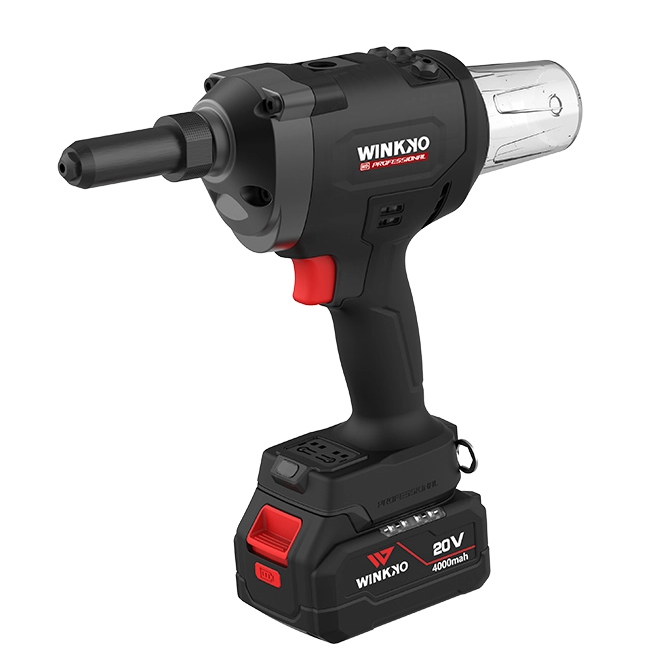
To see how these premium features come together, examine the Winkko HRG201BL Cordless Rivet Gun. This specific model serves as an excellent benchmark for heavy-duty applications. It features a high-efficiency 20V brushless motor, a massive 27mm stroke length, and an impressive 20,000N of pulling force. Furthermore, it includes a transparent mandrel collector and an LED work light for dark spaces. For professionals upgrading their toolkit, examining this tier of equipment provides a clear standard of what to expect from a modern fastening device.
Cost Analysis: The True ROI of Switching to Cordless
Financial decision-makers often fixate on the initial retail price of new equipment. While a bare battery-powered rivet gun paired with lithium-ion batteries carries a higher upfront cost than a standard pneumatic gun, a comprehensive Total Cost of Ownership analysis reveals a remarkably strong Return on Investment.
Upfront Cost vs. Hidden Infrastructure
A pneumatic tool appears cheap on a retail shelf, but it is merely the endpoint of a highly expensive infrastructure. The true cost of a pneumatic system must include the massive purchase price of the industrial air compressor, high-quality hoses, quick-connect fittings, inline oilers, and moisture separators. When factoring in these necessary components, the initial capital expenditure for a functional pneumatic setup often exceeds that of a premium cordless kit.
The Hidden Expense of Compressed Air
Energy auditors widely consider compressed air to be the most expensive utility in an industrial facility. Compressors require substantial electricity to run. Moreover, pneumatic systems are highly prone to microscopic air leaks. Industry audits frequently reveal that up to thirty percent of a compressor output is lost to leaks in hoses and fittings. Eliminating the compressor instantly slashes utility bills and removes the recurring costs of replacing worn hoses.
Productivity Gains and Labor Optimization
The most significant factor in the ROI calculation is pure labor efficiency. If an operator spends just fifteen minutes per day setting up a compressor and untangling hoses, that equates to over sixty hours of lost productivity annually per worker. By switching to a tool that offers instant setup, organizations reclaim those lost hours. This reduction in setup time translates directly into more rivets set per hour, directly boosting the bottom line.
Top Industries Benefiting from the Cordless Revolution
The measurable advantages of battery-powered fastening have driven rapid adoption across multiple industrial sectors. Eliminating air hoses has solved specific logistical nightmares in several key fields.
HVAC and Sheet Metal Fabrication
HVAC technicians frequently assemble sheet metal ductwork in highly restrictive environments like residential attics and commercial drop ceilings. Dragging an air hose through these cramped areas is deeply frustrating and often physically impossible. Relying on a self-contained battery unit significantly accelerates the installation of ducting and plenum boxes.
Automotive Collision and RV Repair
In the automotive repair industry, technicians constantly navigate around hydraulic lifts and rolling toolboxes. Hoses present a constant trip hazard and risk scratching the pristine paint of customer vehicles. Battery-powered riveters are ideal for installing window regulators and securing plastic bumper fascias. In the RV industry, the mobility of a battery-powered tool allows workers to move seamlessly along the entire length of the vehicle to secure aluminum exterior panels.
Commercial Roofing and Solar Installation
Commercial architectural installations almost always take place at significant elevations. Running compressed air lines up multiple stories is dangerous and highly inefficient. Battery-powered tools provide structural-grade pulling force for securing metal flashing and exterior cladding while keeping the roof deck completely clear of tangled hoses. Similarly, solar installers rely heavily on these tools to secure aluminum racking systems safely on pitched roofs.
Conclusion
The shift from pneumatic to battery-powered fastening tools is no longer a future trend. It is the current reality of the manufacturing and construction industries. By entirely eliminating the heavy constraints of air compressors and cumbersome hoses, modern untethered tools have revolutionized how professionals approach metalwork. With uncompromised pulling force, superior mobility, and a clear return on investment, upgrading your equipment is a remarkably smart decision. If you are ready to eliminate trip hazards and boost your assembly speed, visit Winkko to explore high-performance fastening solutions tailored to your specific industrial needs.
FAQ
How long does the battery last on a cordless rivet gun?
Battery life depends heavily on the amp-hour rating of the specific battery pack and the material density of the rivets. On average, a standard 2.0 to 4.0 amp-hour lithium-ion battery can successfully set anywhere from 500 to over 1,000 standard aluminum rivets on a single charge. Setting thicker stainless steel structural rivets will draw more amperage and slightly reduce the total number of cycles. However, by cycling between two batteries on a rapid charger, professionals experience zero downtime during a busy shift.
Can a cordless rivet gun handle stainless steel structural rivets?
Yes, modern battery-powered tools are fully capable of handling structural stainless steel rivets. High-end professional models equipped with brushless motors and heavy-duty planetary gear systems are specifically engineered to generate massive pulling force. Premium tools produce traction power exceeding 20,000 Newtons, which is more than sufficient to snap structural stainless steel mandrels cleanly in a single stroke.
Are cordless rivet guns heavier than pneumatic ones?
When comparing the bare tool weights side-by-side, a battery-powered unit with a lithium-ion battery attached is generally heavier than a bare pneumatic gun. However, this metric is misleading in practical applications. When using a pneumatic tool, the operator must constantly fight the heavy drag and resistance of a pressurized air hose. Because the battery-powered tool operates completely untethered, the perceived weight and resulting operator fatigue are often significantly lower during a full workday.
What maintenance is required for a cordless rivet gun?
Unlike traditional pneumatic tools that require daily lubrication and constant monitoring of air-line moisture to prevent internal rusting, battery-powered models are incredibly low maintenance. The primary upkeep involves keeping the interchangeable nosepieces clean and free of debris. Operators should occasionally open the jaw assembly to clear out accumulated metal shavings and apply a small amount of machine grease to the pusher jaw. Emptying the mandrel collection cup regularly is also necessary to prevent mechanical jamming.
Will my existing power tool batteries work with a new cordless rivet gun?
Compatibility depends entirely on the manufacturer and their specific battery ecosystem. Many leading tool brands design their fastening tools to operate seamlessly on their proprietary 20V battery platforms. If you are purchasing a specialized industrial tool, it is crucial to verify battery compatibility beforehand. In many cases, we highly recommend purchasing a complete kit that includes the tool, optimized batteries, and an appropriate smart charger to ensure maximum performance.
What happens if a rivet gets jammed in a cordless rivet gun?
Jams occasionally happen if the mandrel collection cup overfills or if debris clogs the internal jaw mechanism. Modern tools feature smart electronics that instantly cut power to the motor when they detect a jam, preventing the internal gears from stripping. To clear a jam, simply remove the battery for safety, unscrew the nosepiece and outer housing, and use a pair of needle-nose pliers to extract the stuck mandrel. Keeping the jaws clean and lightly greased prevents most jamming issues.
Are cordless rivet guns suitable for high-volume assembly lines?
Absolutely. While early generations struggled with cycle speed and thermal management, today's brushless models are purpose-built for continuous industrial use. They match the rapid cycle times of pneumatic tools while running significantly cooler. By setting up charging stations directly at the workstation, operators can swap batteries in seconds, making these tools highly efficient for high-volume manufacturing environments without the clutter of air lines.